
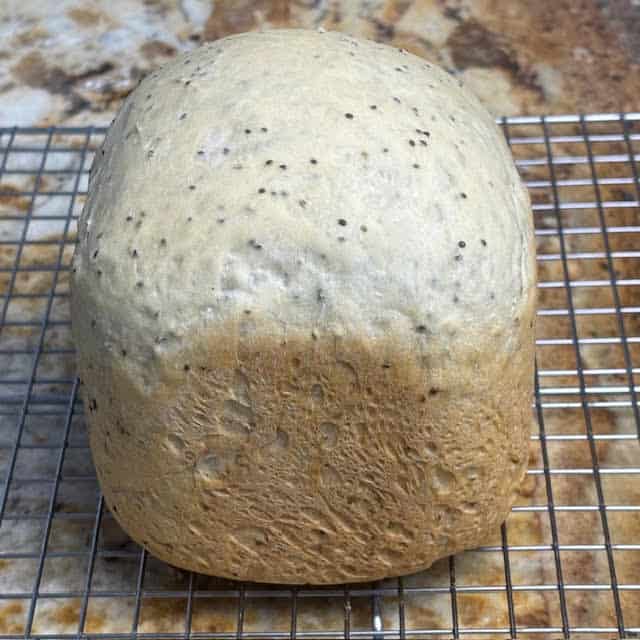
This 1 lb bread machine chia seed bread creates a soft white bread with extra chia seeds. The chia seeds add extra soluble & insoluble fiber to this small but tasty sandwich bread.
Recipe Sections
My 1 lb bread machine recipes are ONLY for small compact bread machines (such as the Briskind Compact Bread Maker or Zojirushi Mini Breadmaker). 1 lb bread machine recipes do NOT work well in bread machines that have 2 lb or greater loaf capacities. See my tips section below for more information.
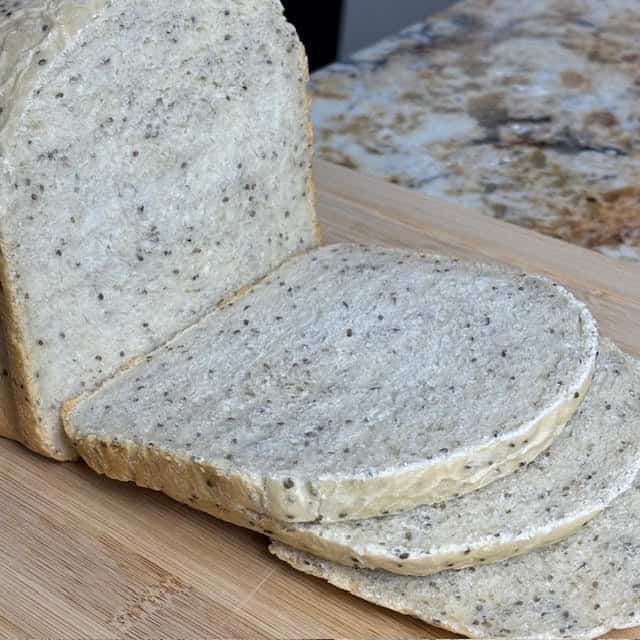
Slices of 1 lb Chia Seed Bread
Ingredients – 1 lb Bread Machine Chia Seed Bread
- 7/8 Cup – Milk (warm) – 207 milliliters – 7/8 cup equals 3/4 cup plus 2 tablespoons
- 2 Tablespoons – Olive Oil – 30 milliliters – Or use 2 tablespoons of softened/melted butter if you prefer a buttery tasting bread.
- 2 Cups – Bread Flour – 240 grams
- 1 Tablespoon – White Granulated Sugar – 12.5 grams
- 3/4 Teaspoon – Salt – 4.5 grams
- 3/4 Teaspoon – Bread Machine Yeast (instant yeast) – 2.7 grams – Not active dry yeast
- 2 Tablespoons – Chia Seeds – 26 grams – Use whole seeds & not ground chia seeds. Do not pre-soak the seeds. Also this ingredient uses tablespoons (not teaspoons).
Servings – Roughly 9 slices
Equipment Needed – Measuring cup & spoons, silicone spatula, oven mitts, cooling rack and a bread machine.
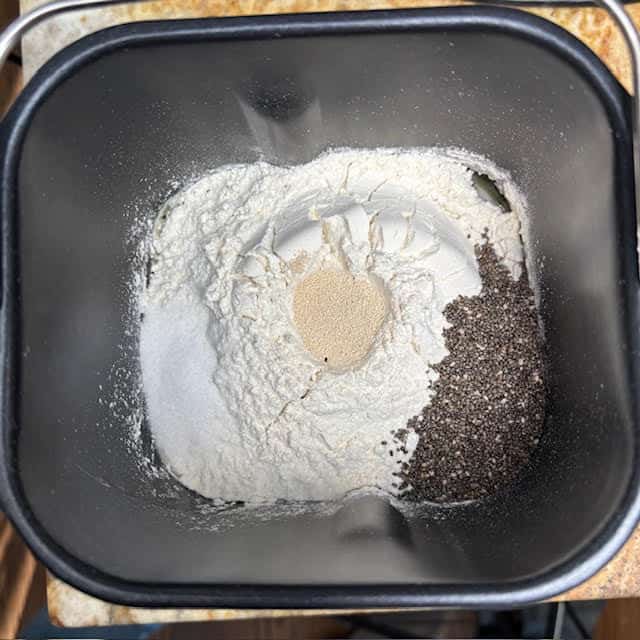
Ingredients for Chai Seed Bread
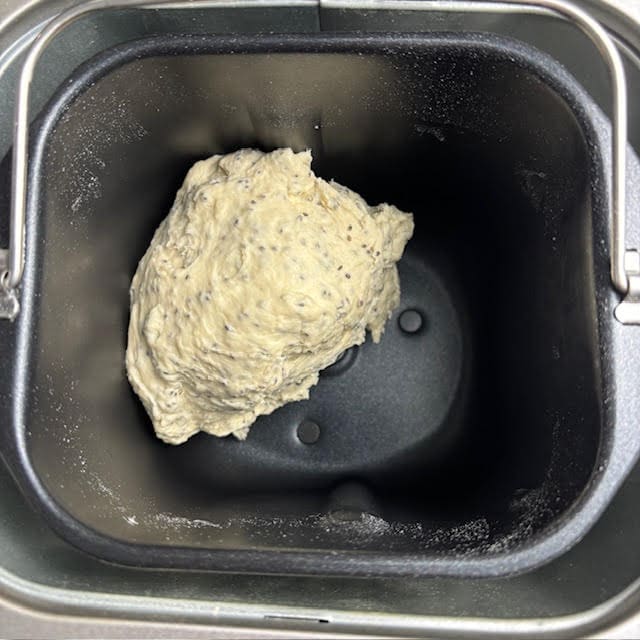
Chia Seed Bread Dough Being Mixed & Kneaded
Instructions
- Bread machine settings – 1 pound loaf, light color and “basic/white” bread setting.
- Unplug your bread machine.
- Remove the bread pan from the unplugged bread machine (so when you add the ingredients, they can not accidentally spill into the machine).
- Pour the milk into the bread pan and then add the other ingredients. Place the bread machine yeast in last and the yeast should not touch the liquid or salt (until the bread machine is turned on and the ingredients start to be mixed together by the bread machine).
- Put the bread pan with ingredients back into the unplugged bread machine.
- Plug in bread machine. Enter the correct settings (1 lb, light color & basic/white bread) and press the “start” button.
- When the bread machine has finished baking the bread, unplug the bread machine and remove the bread pan from the bread machine. Wear oven mitts as the bread pan & bread machine will be hot.
- Remove the bread from the bread pan and place the bread on a cooling rack. Use oven mitts when removing the bread as the bread & bread pan will be hot.
- Let the bread cool on the cooling rack for 1 to 2 hours before cutting.
- Please read the tips section below for extra information on how to make this recipe successfully & to avoid common bread machine problems.
If you liked this recipe, please leave a comment below & give us a 5 star rating. Jump to comment section
Love bread machine recipes? Subscribe to my Bread Dad newsletter.
Get Recipes🛠 Bread Dad’s Troubleshooting Guides
- Collapsed Loaf: Why Did My Bread Machine Bread Collapse?
- Dense Bread: Why Is My Bread Machine Bread So Dense?
- Common Problems: 25+ Bread Machine Mistakes
- Banana Bread: Why Did My Banana Bread Sink In The Middle?
Helpful Tips
- The tips below are designed to help bread machine “novices” and those who haven’t touched their bread machine in years.
- Click on this “print recipe” link if you want to print out this recipe. It includes all of the recipe’s ingredients and instructions. However, the recipe print function does not include my tips section. Please read the tips section in order to avoid common recipe problems.
- If you want to make a larger version of this chia seed bread, check out my main Bread Machine Chia Seed Bread page (because it focuses on 1.5 lb and 2 lb loaves).
- This recipe is part of Bread Dad’s series on easy 1 lb Bread Machine Recipes such as banana bread, whole wheat bread, oatmeal bread and super soft white bread.
- As I stated at the top of the page, this recipe is ONLY for small compact bread machines.
- 1 lb bread machine recipes generally do NOT work well in larger machines with 2 lb loaf capacities, especially if the machines have 2 paddles or a wide horizontal bread pan. However, some visitors have success making 1 lb recipes in a 2 lb “compact” bread machine with a vertical-oriented bread pan (a pan with a square bottom that mainly pushes the bread upwards versus a pan with a wide rectangular bottom)
- If you use larger bread machines with 2 paddles or a wide horizontal bread pan, a 1 lb loaf usually comes out more like a pancake (with lots of exterior crust and less of the soft interior).
- FYI – I have added a page to Bread Dad with Bread Machine Pan Sizes for a number of popular bread machines. This should help you to determine if your machine is capable of handling Bread Dad’s 1 lb, 1.5 lb or 2 lb recipes.
- WARNING – Since 1 lb recipes use smaller amounts of ingredients, it is easier to mess up 1 lb recipes!! There is less room for measuring errors versus larger loaves. To make 1 lb loaf recipes successfully, you need to measure accurately (no eyeballing ingredients).
- The top of your bread can sometimes be a little lumpy due to the smaller amounts of ingredients in a 1 lb loaf. Why? Because, as I stated above, there is less room for measurement errors in small loaves versus large loaves. A little too much moisture or flour has a bigger impact on a 1 lb loaf versus a 2 lb loaf.
- As I have gotten older, I find that I need more fiber in my diet. To get more fiber, I have been adding chia seeds to my morning oatmeal and to my yogurt. Therefore, I thought lets see what happens if I add chia seeds to a white bread recipe! I thought this would be a super easy way to add fiber to a sandwich bread.
- Moreover, some of my family members don’t like the taste of whole wheat. So for these non-whole wheat people, I wanted to create a “fiber bread” which tasted more like a white bread. Got to make everybody happy!
- The result – My 1 lb bread machine chia seed bread is very soft & tasty sandwich bread because it is basically a white bread with chia seeds thrown in.
- I also like the “speckled” look of the bread (dots everywhere). It gives the sandwich bread an attractive & different looking appearance.
- Chia seeds have roughly 4 or 5 grams of fiber per tablespoon. Nevertheless, be aware that this fiber estimate can vary by manufacturer. So check the nutrition label on your chai seed package for the exact amount. According to the nutrition label on the Bob’s Red Mill chia seeds package that I like to use, there are 10 grams of dietary fiber in 2 tablespoons of their chia seeds. However, some other manufacturers have lower numbers on their chia seed packages.
- Chia seeds have a lot of insoluble fiber. It is estimated that the fiber in chia seeds is 70-80% insoluble and 20-30% soluble. For more information about the differences of insoluble and soluble fiber, you should read the Wikipedia article on Dietary Fiber.
- Bread flour has some (not much) fiber too. Bread flour has roughly 3 grams of fiber per cup. In contrast, whole wheat flour has roughly 10 to 15 grams per cup. According to the nutrition label on my package of King Arthur Baking whole wheat flour, their whole wheat flour has 12 grams of fiber per cup (3 grams per 1/4 cup).
- Therefore, based on the info above, I estimate that my 1 lb Bread Machine Chia Seed Bread has ROUGHLY 16 grams of fiber (10 grams of fiber from 2 tablespoons of the chia seeds and 6 grams of fiber from the 2 cups of bread flour).
- In comparison, my 1 lb Bread Machine White Bread has roughly 6 grams of fiber (based on 6 grams of fiber from 2 cups of bread flour) and my 1 lb “soft” Bread Machine Whole Wheat Bread has roughly 15 grams of fiber (based on 3 grams of fiber from 1 cup of bread flour and 12 grams of fiber from the 1 cup of whole wheat flour). However, my bread machine 100% whole wheat bread recipe has roughly 24 grams of fiber (based on 24 grams of fiber from 2 cups of whole wheat flour).
- Of course, these are VERY ROUGH estimates and they can VARY based on the ingredients used, amount of ingredients used, etc.
- So you are getting a decent amount of fiber with my bread machine chia seed bread. It has as much as my soft whole wheat bread (which uses a 50/50 mix of whole wheat flour and bread flour).
- However, my chia seed bread has less fiber than my 100% whole wheat bread. Nevertheless, the chia bread is much softer and fluffier than my 100% whole wheat bread.
- Chia seeds also contain other nutrients such as omega-3 fatty acids. For more on the benefits of chia seeds, you should read this Harvard Health article.
- The chia seeds may add a slightly nutty flavor to the bread but the taste is very mild.
- You generally can find chia seed packages in the baking section of many major supermarkets in the USA. They are also easy to buy online.
- Visitors – Why do you like to eat chia seeds? And do you add them to your bread or other baked goods? Please post your chia seed thoughts & baking ideas in the comment section below.
- Do NOT use cold milk. The main problem with using regular milk is that people tend to use cold refrigerated milk and this can slow the yeast growth. Try to use warm milk (or instant powdered milk mixed into warm water). If the milk is just coming out of the refrigerator and thus is too cold, I like to put the milk in my microwave for 15-20 seconds in order to warm it up. However, you should also be aware that the milk/water should not be too hot because very hot milk/water can kill the yeast.
- Optional – If you want to make an even softer chia seed bread, you should use buttermilk instead of milk. The slight acidity of buttermilk tenderizes the bread (in part by softening the gluten).
- Optional – If your family doesn’t drink dairy milk, you can use non-dairy milk substitutes such as plain (non-flavored) soy milk, oat milk, etc.
- Or you can use water to replace the milk. However, the bread will be a little less tasty (versus breads made with milk).
- The ideal temperature for liquid ingredients used when making bread machine bread is around 100 to 110 F. Cold liquids (such as water & milk straight from the refrigerator) will slow yeast growth and liquid ingredients that are 140 F or above can kill the yeast. Some people like to use a digital bread thermometer in order to measure the temperature of their liquid ingredients.
- Optional – If you want to make a dessert with chia seeds, you might like my Chia Seed Banana Bread recipe.
- Always use FRESH ingredients (e.g. bread flour and yeast) for the best results. Ingredients that have been sitting in the pantry for months can become stale or pick up weird smells & flavors.
- Try to keep your ingredients (e.g. flour) in airtight food containers in order to extend their shelf life. Airtight containers protect ingredients from moisture (in the air), pests, dust, etc.
- Flour absorbs moisture from the air (if kept in an open bag and not an airtight container). This extra moisture throws off recipes and can lead to bread collapses, etc.
- Although 99% of the time my recipes do not need any extra attention, I still like to check the dough in my bread machine after the first 4 or 5 minutes of mixing. Factors such as flour absorbing moisture from the air, a humid kitchen or minor inaccuracies in measuring ingredients can all affect the dough’s consistency. If the dough is looking too wet (semi-soupy), I add some flour (a little bit at a time) until the dough consistency looks correct. Check your bread machine’s instruction manual on how to do this safely & effectively with your specific machine.
- To make my 1 lb bread maker recipes, I own & use a Briskind Compact Bread Maker Machine. In case you are interested, another popular (but more expensive) bread machine focused on making 1 lb loaves is the Zojirushi BB-HAC10 Mini Breadmaker. Many of my visitors also have success making 1 lb loaves with the Cuisinart Compact Bread Maker (model # CBK-110).
- In case you are looking at getting a bread machine to make 1 lb recipes, here are some of the benefits of a small compact bread machine; 1 lb loaves are perfect for single people or people who don’t want a ton of bread, a compact machine takes up less space in the kitchen (so more convenient for an apartment versus buying a giant bread machine), it uses less energy than a large bread machine, it creates smaller sandwich slices (sometimes, in my opinion, the slices from 2 lb loaves are too large – especially for kids), etc.
- The disadvantages of a small compact bread machine; small bread pan capacity (so you can’t make a larger loaf if you have guests coming over), not many online recipes are focused on 1 lb loaves, sometimes 1 lb loaves have more uneven crusts (vs bread made with larger horizontal bread pans), etc.
- Visitors – What compact bread machine did you use to make this recipe (such as Briskind Compact Bread Maker, Zojirushi Mini Breadmaker or Cuiniart Compact Bread Maker)? Please post your machine & any compact bread machine tips in the comment section below.
- Make sure to level off the ingredients in your measuring spoons & cups. No “mountains” of ingredients in your spoons & cups!! If you add too much of an ingredient, you can have a baking problem.
- Or if you have a kitchen scale, you can weigh your ingredients for the most consistent results. You will find gram/milliliter measurements in the recipe’s ingredient list. FYI – Many Europeans prefer to weigh their ingredients versus using measuring cups & spoons.
- FYI – I always like to give my flour container a quick shake in order to aerate and fluff the flour before I measure it with a measuring cup. This easy method helps to reduce the chance of using heavily compacted flour.
- You should let your bread COMPLETELY cool down before slicing. If you try cutting bread while it is still warm, you will squash & compress the bread and interfere with the bread slowly releasing the steam/water vapor from the interior. Premature slicing can negatively impact the bread by making the bread more gummy. FYI – It can take 1 to 2 hours for a bread to completely cool.
- Do not overbake your sandwich bread!! As soon as the bread machine done, you should remove the pan from the machine and then remove the bread from the pan. This applies to most sandwich breads made with a bread machine but always follow the recipe’s instructions for the best results.
- Do not forget the bread & let it sit in the bread machine or pan after the machine has finished baking. The residual heat will continue to bake the bread, drying it out and the loaf will turn into a rock!!
- Cool your bread on a wire cooling rack. This type of rack allows moisture to escape via all the sides of the bread (including the bottom of the loaf). FYI – A lot of moisture escapes through the paddle hole in the bottom of the bread.
- If you place bread on a cutting board or plate to cool down, the bottom of the loaf will become soggy. The escaping moisture has nowhere to go and is trapped by the plate/cutting board. This means that the bottom of your bread just sits in the trapped moisture.
- This 1 lb bread machine recipe is based on bread flour (and not all purpose flour). A bread made with all purpose flour will NOT be as good as one made with bread flour. Most sandwich bread recipes use bread flour because bread flour has more gluten than all purpose flour. This helps to add “structure” to the bread and capture more of the CO2 “bubbles” put out by the bread yeast. Thus bread flour breads tend to be fluffier than all purpose flour breads.
- Moreover, since all purpose flour has less gluten than bread flour, breads made with all purpose flour do not hold together as well as breads made with bread flour. Gluten provides structural strength to bread. Breads made with all purpose flour will in general “crumble” and/or break more easily when sliced (versus breads made with bread flour).
- This bread machine recipe will NOT work with gluten free flour.
- My recipe uses bread machine yeast (instant yeast). It does NOT use active dry yeast.
- Bread machine yeast and instant yeast are not the same as active dry yeast. Bread machine yeast and instant yeast are added directly to the recipe’s ingredients. In contrast, active dry yeast must be activated in water/milk before being added to a recipe’s ingredients. If you try to use active dry yeast for this recipe, it is much less likely to work properly (as the recipe instructions & leavening time is based on the use of bread machine yeast). Examples of yeast that can be used for this recipe include Fleischmann’s Bread Machine Yeast, Fleischmann’s Instant Yeast, Saf Instant Yeast, Red Star Instant Yeast, etc. You should not use active dry yeasts for this recipe such as Fleischmann’s Active Dry Yeast, Red Star Active Dry Yeast, etc.
- I would recommend NOT reducing the salt in this recipe. You generally want to keep the salt-to-yeast ratio at a 1:1 basis in most bread recipes (1:1 based on teaspoons to teaspoons and NOT grams to grams). The salt moderates the growth of the yeast. If you cut the salt (and disrupt this 1:1 ratio), the yeast will grow faster than expected. In turn, this leads to more bread collapses (because the yeast rises too high and then craters in the middle) and/or results in “slack” less manageable dough. In addition, less salt will impact the flavor and browning of the bread.
- Do NOT place the yeast on top of or next to the salt. Salt kills yeast so it must be placed away from the yeast in the bread pan.
- I like to place my yeast in the middle of the bread pan (within a small “pocket” in center of the flour) and the salt on the side of the pan.
- If you haven’t used your bread machine or bread maker in a long time, please buy some NEW bread machine yeast before making your bread. Old yeast can die or lose its potency and this will lead to bread that does not rise properly. Bread machine yeast is not likely to be viable if it has been sitting in your pantry for years.
- Bread machine yeast loses its potency over time. Generally, bread machine yeast lasts for only 3-4 months after you have opened the bottle. However, if the yeast is exposed to air & moisture (e.g. the bottle is not sealed tight) or exposed to higher temperatures, the yeast will expire even more quickly.
- If your bread comes out too dense, it is likely due to one of the following reasons; You are using old or stale yeast, using a cold refrigerator temperature liquid (which slows yeast growth), baking in a cold winter temperature kitchen (yeast likes kitchen temps of 75-80 degree F), using all purpose flour (versus bread flour as called for in the recipe), placing salt on top of or next to the yeast (salt kills yeast so it must be placed away from the yeast in the bread pan), etc. For more reasons, you should visit Bread Dad’s Why Is My Bread Machine Bread So Dense? page.
- Cooler home temperatures in the winter can cause rising problems for bread dough. Ideally, your room temperature should be around 75-80 degrees F. Colder winter room temperatures can significantly delay the rise of the dough. You will need to raise the temperature of your kitchen (if you like a cold house in the winter) or find a warm spot for the dough to rise. I often put my dough (covered of course) next to a heating vent in the winter to make sure it is getting enough heat.
- Conversely, dough can rise faster than expected in a very hot kitchen.
- Kitchen humidity can impact a recipe. A winter kitchen tends to be drier due to your heating system drying out the air. In contrast, a kitchen in the summer can be much more humid. This change in humidity impacts baking as flour can soak up humidity from the air. Therefore, you might have to add 1-2 teaspoons of liquid in the winter if the dough is looking too dry. Or you might have to add 1-2 teaspoons of flour in the summer if the dough is looking too wet. If your kitchen is very dry or humid, you might have to add even a little more (but start with 1 teaspoon at a time until you achieve the right consistency). Of course, excessive kitchen humidity or dryness can impact a recipe at any time during the year (not just in the summer & winter)!
- This is one of the reasons that people should store flour in an airtight container if they have already opened the flour package. The flour will pick up extra moisture from the air while sitting in the pantry and this can throw off recipes, spoil flavor, degrade shelf life, etc.
- Having trouble with bread collapses & misshapen bread tops? Make sure to read Bread Dad’s article on Bread Machine Bread Collapses. It has reasons and solutions to potential bread collapses.
- For information on other possible errors, please visit my Common Bread Machine Mistakes page.
- If you have a problem with a “basic” bread machine recipe, please make sure that you are following the recipe exactly (e.g. using the correct bread machine settings), using the correct amount of an ingredient (e.g. don’t eyeball the measurements versus using a measuring cup or accidentally add a tablespoon when a teaspoon is called for), using the correct ingredients (e.g. bread machine yeast versus regular yeast or bread flour versus all purpose flour), etc. Please don’t “wing” things with recipes.
- If you start substituting ingredients (e.g. using different types of flour not called for in the recipe), you are experimenting and should not expect similar results to the recipe shown above. Experimenting can be fun. However, you should expect some successes but more potential disappointments when you start to experiment with recipes. For example, if you substitute whole wheat flour for bread flour, you will probably experience a problem (as whole wheat flour doesn’t rise nearly as well as bread flour). Moreover, whole wheat flour has a totally different flavor.
- You can also use this homemade bread to make one of Bread Dad’s hot & toasty Grilled Cheese & Panini Sandwich Recipes. These recipes include air fryer grilled cheese, chicken paninis and ham & cheese paninis.
- My recipes are based on US ingredient measurements (e.g. US cups & tablespoons). However, as a courtesy to our European visitors, I have also included some very ROUGH European equivalents (e.g. grams & milliliters). Since I rarely use European measurements when baking, please let me know in the comment section below if any of the European ingredient measurements need to be changed (e.g. for XYZ ingredient, milliliters are more commonly used versus the grams information listed in the recipe).
- Before using any bread machine, you should read the bread machine manufacturer’s instructions in order to use the bread machine effectively and safely.
- Always wear oven mitts/gloves when dealing with a bread machine. The bread pan and the rest of the bread machine can get very hot during the baking process. This means that the bread pan and bread machine is likely to be very hot when you attempt to remove a baked good from the bread machine and/or bread pan.
- For more easy bread ideas, please visit Bread Dad’s section on Bread Machine Recipes.
If you liked this recipe, please leave a comment below & give us a 5 star rating. Jump to comment section
Love bread machine recipes? Subscribe to my free Bread Dad newsletter.
Want more Bread Dad recipes? Check out these sections:
- Bread Machine Recipes – 90+ recipes such as banana bread, sourdough bread, pizza dough, cinnamon raisin bread, etc.
- Bread Recipes – French bread, buttermilk bread, bagels, Italian bread, etc.
- Banana Bread Recipes – 60+ recipes such as banana nut bread, eggless banana bread, blueberry banana bread, etc.
- Quick Bread Recipes – Recipes using baking soda such as pumpkin bread, cranberry bread, gingerbread, etc.
- Muffin Recipes – Muffins are delicious “mini” versions of banana breads & quick breads!
Reference Sources
- Wikipedia, Bread Machine
- Wikipedia, Chia Seed
- Wikipedia, Dietary Fiber
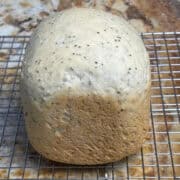
1 lb Bread Machine Chia Seed Bread
Ingredients
- 7/8 Cup Milk (warm) – 207 milliliters – 7/8 cup equals 3/4 cup plus 2 tablespoons
- 2 Tablespoons Olive Oil – 30 milliliters – Or use 2 tablespoons of softened/melted butter if you prefer a buttery tasting bread.
- 2 Cups Bread Flour – 240 grams
- 1 Tablespoon White Granulated Sugar – 12.5 grams
- 3/4 Teaspoon Salt – 4.5 grams
- 3/4 Teaspoon Bread Machine Yeast (instant yeast) – 2.7 grams – Not active dry yeast
- 2 Tablespoons Chia Seeds – 26 grams – Use whole seeds & not ground chia seeds. Do not pre-soak the seeds. Also this ingredient uses tablespoons (not teaspoons).
Instructions
- Bread machine settings – 1 pound loaf, light color and “basic/white” bread setting.
- Unplug your bread machine.
- Remove the bread pan from the unplugged bread machine (so when you add the ingredients, they can not accidentally spill into the machine).
- Pour the milk into the bread pan and then add the other ingredients. Place the bread machine yeast in last and the yeast should not touch the liquid or salt (until the bread machine is turned on and the ingredients start to be mixed together by the bread machine).
- Put the bread pan with ingredients back into the unplugged bread machine.
- Plug in bread machine. Enter the correct settings (1 lb, light color & basic/white bread) and press the “start” button.
- When the bread machine has finished baking the bread, unplug the bread machine and remove the bread pan from the bread machine. Wear oven mitts as the bread pan & bread machine will be hot.
- Remove the bread from the bread pan and place the bread on a cooling rack. Use oven mitts when removing the bread as the bread & bread pan will be hot.
- Let the bread cool on the cooling rack for 1 to 2 hours before cutting.
- Please read the recipe's tips section on Bread Dad (BreadDad.com) for extra information on how to make this recipe successfully & to avoid common bread machine problems.
Notes
Nutrition
Related Recipes
- 1 lb Bread Machine Cranberry Walnut Bread
- 1 lb Bread Machine Soft Whole Wheat Bread
- 1 lb Bread Machine 100% Whole Wheat Bread
- Chia Seed Banana Bread
- High Fiber Bread – Oven baked
- Seed Bread – Chia seeds, flaxseeds & sunflower seeds
Please leave a comment & recipe rating in the comment box below. Thanks!