
This all purpose flour bread machine recipe creates an old-fashioned country white bread. Moreover, it is simple & easy to make… as your bread machine does most of the hard work!
Have you ever said something like “$&@! I am out of bread flour. How am I going to make some decent bread now?“. Unfortunately, lots of bread recipes call for the use of bread flour. However, there are many times when you find yourself with only all-purpose flour at home (e.g. you ran out of bread flour).
Therefore, I decided to create an easy all-purpose flour bread machine recipe that you can use to create a slightly sweet “country” white bread. It only uses simple ingredients such as milk, butter, eggs… and all purpose flour! This basic white bread is perfect for sandwiches or toast.
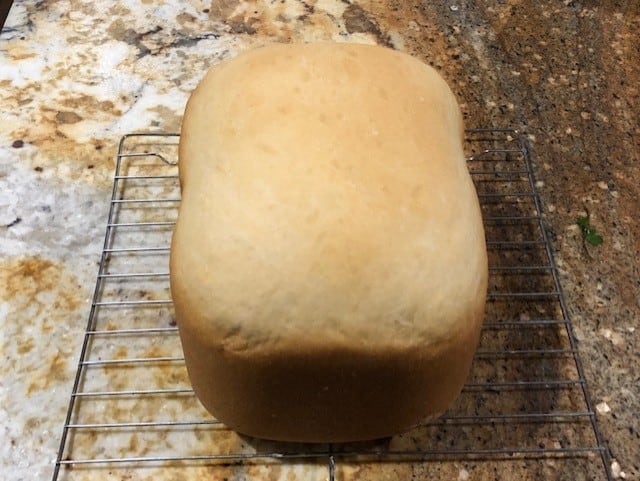
All Purpose Flour Bread Machine Recipe – Finished Loaf
Recipe Sections
| Recipe RatingFeatured Comment Gloria “Simply The BEST bread machine recipe I’ve found, especially considering it’s using regular flour. Such a great, complex flavor, nice crumb, beautiful, soft crust an chewy texture. I’ve never written a recipe comment before, but I’ve never had these great results. I mean, I’ve made a ton of bread in my machine, most all very good with a few duds, but this bread is really, really good, and the crust was perfect.” |
FYI – This bread is baked in your bread machine (and not in your oven). There is also a “how to” recipe video on this page if you want to watch how this recipe is made.
Of course, this is not some fancy artisanal bread… rather, it is a good emergency recipe if you are missing bread flour and only have all purpose flour at home. This recipe allows you to create nice sandwich bread or toast with a bread machine & all purpose flour. Moreover, this easy recipe hopefully saves you from making a special trip to the supermarket in order to buy some bread flour!!!
Sliced Country White Bread (made with All Purpose Flour)

Since all purpose flour has less gluten than bread flour, all purpose flour breads often do not rise as well as bread flour breads. The extra gluten in bread flour helps to “trap” the carbon dioxide produced by the yeast and this results in a better rise. Therefore, to offset this “rising” issue, I added an egg to the bread machine white bread recipe (because eggs have a modest positive leavening effect).
Since this white bread contains eggs, I decided to turn this all purpose flour bread recipe into a slightly sweet country white bread recipe. Country white breads are usually made with milk, butter and eggs… things that you might find on a farm (e.g. in the “country”side). These ingredients help you to produce a more old fashioned but delicious “homemade” type of white bread.
FYI – For details on how to make a 1 lb version of this recipe, please visit my 1 lb Bread Machine All Purpose Flour Bread page.
Ingredients
- 1 Cup – Milk (warm) – 237 milliliters
- 4 Tablespoons – Unsalted Butter (sliced & softened) – 57 grams
- 1 Large Egg (lightly beaten) – 57 grams – Not an extra large or jumbo egg
- 3 Cups – All Purpose Flour – 360 grams
- 1/3 Cup – Light Brown Sugar (packed cup) – 72 grams – However, you should use only 2 tablespoons if you want a non-sweet bread
- 1 Teaspoon – Salt – 6 grams
- 1 Teaspoon – Bread Machine Yeast – 3.6 grams – Not active dry yeast
Servings – Roughly 12 slices
Equipment Needed – Measuring cup & spoons, silicone spatula, oven mitts, cooling rack and a bread machine.
Recipe Video – Watch How This Bread Is Made
FYI – A short ad might play in front of the recipe video.
Instructions
- Settings – 1.5 lb, light color and basic/white bread
- Unplug your bread machine.
- Remove the bread pan from the bread machine (so when you add the ingredients, they can not accidentally spill into the machine).
- Soften the butter in your microwave.
- Lightly beat the egg.
- Pour the milk, butter & egg into the bread pan and then add the dry ingredients. Place the bread machine yeast in last and the yeast should not touch the liquid (until the bread machine is turned on and the ingredients start to be mixed together by the bread machine).
- Put the bread pan with the ingredients back into unplugged bread machine.
- Plug in the bread machine. Enter the correct settings (1.5 lb, light color & basic/white bread) and press the “start” button.
- When the bread machine has finished baking the bread, unplug the bread machine.
- Take the bread pan out of the bread machine.
- Remove the bread from the bread pan and place it on a cooling rack. Use oven mitts when removing the bread pan from the bread machine because it will be very hot! Let the bread cool down on the cooling rack for at least 1-2 hours.
- Please read the tips section below for extra information on how to make this recipe successfully & to avoid common bread machine problems. You also can watch my recipe video to “see” how to perform each recipe step.
If you liked this recipe, please leave a comment below & give us a 5 star rating. Jump to comment section
| Want my recipes sent to your inbox? Join Bread Dad’s recipe newsletter |
Key Ingredient – All Purpose Flour

Helpful Tips
- The tips below are for bread machine “novices”. Hopefully, these tips will help you to maximize the success of your bread machine white bread.
- Click on this “print recipe” link if you want to print out this recipe. It includes all of the recipe’s ingredients and instructions. However, the recipe print function does not include our tips section. Please read the tips section in order to avoid common recipe problems.
- If you would rather “see” how this recipe is made, please watch the step-by-step recipe video on this page. It is a short & simple video that shows you how to make this recipe.
- This recipe is part of Bread Dad’s series on easy Bread Machine Recipes such as buttery white bread, banana bread, multigrain bread and French bread.
- As I said at the top of the page, this recipe does not produce a fancy artisanal bread… as we are using a bread machine! Rather, this recipe creates a nice EMERGENCY white bread if you don’t have any bread flour at home.
- As you probably know, all purpose flour is used to make many types of baked goods (e.g. cookies, cakes… and bread!) whereas bread flour is used primarily for making bread. Most of us have tons of all purpose flour at home (because it is used in so many recipes) but we might not have any bread flour. Therefore, in order to save you from a trip to the supermarket in order to buy bread flour, I created a simple white bread recipe that uses all purpose flour.
- Bread made with all purpose flour will be a little more dense than bread made with bread flour. All purpose flour has less gluten than bread flour. Less gluten means a lower ability to trap the CO2 bubbles put out by the yeast (and thus a less airy bread).
- This bread machine white bread recipe makes what is known as a country white bread or farm bread. This type of bread uses typical farm (country-side) ingredients such as milk, butter and eggs.
- Country white breads are an old-fashioned style of sandwich bread with (in my opinion) a nice homemade taste. However, if you are looking for an extra soft white bread, you should try Bread Dad’s Bread Machine Buttermilk Bread. Or if your family can’t eat eggs, you should try my buttery Bread Machine White Bread.
- This recipe is NOT for 1 lb capacity bread machines. Please check the capacity of your bread machine before making this recipe. This recipe helps you to create a 1.5 lb bread loaf. If you have a small bread machine (e.g. a bread machine that has only a capacity for 1 lb breads), you will be unable to make this recipe. The loaf will be too large for your machine and could overflow the bread pan (and the top is likely to collapse).
- FYI – If you own a small compact bread machine, you should use my 1 lb Bread Machine All Purpose Bread recipe. It is the 1 lb version of the recipe found on this page.
- I have also added a page to Bread Dad with the Bread Machine Pan Sizes for a number of popular bread machines. This should help you to determine if your machine is capable of handling Bread Dad’s 1 lb, 1.5 lb or 2 lb recipes. For example, some bread machines with a “2 lb loaf capacity” are better suited for my 1.5 lb recipes (as they can’t handle my fluffy 2 lb recipes) and some are better with my 2 lb recipes (as their pans have lots of extra space).
- Milk and butter help to provide a richer flavor to bread machine white bread recipes. These ingredients also help to soften white breads. Eggs help with things such as color, leavening, structure and moisture in this all purpose flour bread machine recipe.
- The interior of country white breads is usually white with a slight tinge of yellow because of the eggs.
- The brown sugar adds a slightly richer & deeper flavor (versus using highly processed white granulated sugar). It helps to create a slightly sweet country white bread. However, if you like non-sweet bread then use only 2 tablespoons of brown sugar.
- If you make the a less sweet version of this bread (e.g. use 2 tablespoons of brown sugar versus the 1/3 cup), you should consider adding 1 teaspoon of Italian seasoning or dried rosemary in order to enhance the flavor. You will be making a country “herb” bread!! However, I would not recommend adding the herbs to the sweeter 1/3 cup version (as the flavors of the sugar & spices are more likely to conflict).
- If you make the lower sugar version, the bread will be slightly denser (as the yeast will have less sugar to feed on and this will slow yeast growth).
- Visitors – What do you add to your breads in order to improve them or to make them more unique? For example, do you add extra ingredients such as dried herbs, cinnamon, chopped walnuts, raisins, etc. Please post your ingredient additions in the comment section below. Your recipe tips are a great help to beginning bakers.
- Do NOT use cold milk to make this recipe. The main problem with using regular milk is that people tend to use cold refrigerated milk and this can slow the yeast growth. Try to use warm milk (or instant powdered milk mixed into warm water). However, you should also be aware that the milk/water should not be too hot because very hot milk/water can kill the yeast.
- You can use low fat milk to make this recipe. However, I think that whole milk creates a bread with more flavor.
- Optional – If your family can’t drink dairy milk, you can use non-dairy milks such as soy milk, oat milk, etc. You can even use water if you have nothing else (but milk helps to provide some extra flavor to the bread).
- This recipe is based on using a large egg and NOT an extra large or jumbo egg (US egg-size designations). According to Wikipedia, a large egg weighs 57 grams, an extra large egg weighs 64 grams and a jumbo egg weighs 71 grams. If you use an extra large or jumbo egg, you will be adding too much liquid and this will throw off the recipe.
- This recipe uses bread machine yeast (instant yeast). It does NOT use active dry yeast. Bread machine yeast and instant yeast are not the same as active dry yeast. Bread machine yeast and instant yeast are added directly to the recipe’s ingredients. In contrast, active dry yeast must be pre-activated for 5-10 minutes in water/milk before being added to a recipe’s ingredients.
- If you haven’t used your bread machine or bread maker in a long time, please buy some NEW bread machine yeast before making your bread. Old yeast can die or lose its potency and this will lead to bread that does not rise properly. Bread machine yeast is not likely to be viable if it has been sitting in your pantry for years. Moreover, if the bread machine yeast is exposed to air & moisture (e.g. the bottle not sealed tight) or is exposed to higher temperatures, the yeast will expire even more quickly.
- Once you have opened the bottle that contains the bread machine yeast, the yeast will last longer if you store the bottle in the refrigerator or freezer. Just make sure the bottle is sealed tight.
- If your dough is having trouble rising properly, you should check out my How To Test Yeast page. This yeast test will show you if your yeast is alive & active or dead/expired. It will save you from a few bread disasters!
- Always use FRESH ingredients (e.g. bread flour and yeast) for the best results. Ingredients that have been sitting in the pantry for months can become stale or pick up weird smells & flavors.
- Try to keep your ingredients (e.g. flour) in airtight food containers in order to extend their shelf life. Airtight containers protect ingredients from moisture (in the air), pests, dust, etc.
- Flour absorbs moisture from the air (if kept in an open bag and not an airtight container). This extra moisture throws off recipes and can lead to bread collapses, etc.
- Although 99% of the time my recipes do not need any extra attention, I still like to check the dough in my bread machine after the first 4 or 5 minutes of mixing. Factors such as flour absorbing moisture from the air, a humid kitchen or minor inaccuracies in measuring ingredients can all affect the dough’s consistency. If the dough is looking too wet (semi-soupy), I add some flour (a little bit at a time) until the dough consistency looks correct. Check your bread machine’s instruction manual on how to do this safely & effectively with your specific machine.
- This recipe will NOT work with gluten free flour. Gluten free flour differs significantly versus flours with gluten and requires you to use recipes specifically designed for the use of gluten free flour. If you use gluten free flour in this recipe, you are likely to have a baking disaster.
- If you would like to read my review of the bread machines that I own & use to create my bread machine recipes, please visit my Best Bread Machines page. It covers bread machines such as Hamilton Beach, KBS and Zojirushi. The page points out their strengths and weaknesses.
- Many bakers (myself included) like to make an indent in the top of the flour in order to hold the bread machine yeast in place (looks sort of like a small flour volcano with a yeast crater). This is done to prevent the yeast from falling into the liquid ingredients (and activating prematurely), coming into contact with the salt, etc. until the bread machine is turned on.
- I would recommend NOT reducing the salt in this recipe. You generally want to keep the salt-to-yeast ratio at a 1:1 basis in most bread recipes (1:1 based on teaspoons to teaspoons and NOT grams to grams). The salt moderates the growth of the yeast. If you cut the salt (and disrupt this 1:1 ratio), the yeast will grow faster than expected. In turn, this leads to more bread collapses (because the yeast rises too high and then craters in the middle) and/or results in “slack” less manageable dough. In addition, less salt will impact the flavor and browning of the bread.
- If you use measuring cups, you need to make sure the ingredients have been leveled flat with the rim of the cup. No heaping mountain of ingredients. In addition, many people (esp. Europeans) like to use a kitchen scale to measure an ingredient’s weight. This helps to avoid issues such as the use of heavily compacted flour versus fluffed flour. Cups of heavily compacted flour (vs fluffed flour) can add too much flour and this can make the dough too dry.
- Sometimes a little flour will stick to the sides of the bread pan during the mixing process. Therefore, during the “pause” between the first and second mixing cycle (when the mixing paddle has fully stopped), I like to scrape the flour from the inside of the bread pan with a soft flexible spatula. Of course, always wear oven gloves when dealing with a bread machine & don’t put your hands inside the machine.
- Do not leave the bread in the bread pan (or the bottom may become too moist). Unlike a quick bread recipe (e.g. banana bread), regular bread should be removed from the bread pan as soon as it is taken out of the bread machine.
- After removing the bread from the bread pan, don’t forget to remove the mixing paddle if it is stuck in the bread. Use oven mitts as the mixing paddle will be very hot coming out of the bread machine. Or wait until the bread is completely cooled and then remove the mixing paddle.
- Before cutting the bread, you should allow it to completely cool. Otherwise, the sliced bread will come out “gummy”. The cooling process is essential for the creation of good breads (because it allows excess moisture to escape as the bread cools). This helps to create a firm and airy bread.
- Kitchen humidity can impact a recipe. A winter kitchen tends to be drier due to your heating system drying out the air. In contrast, a kitchen in the summer can be much more humid. This change in humidity impacts baking as flour can soak up humidity from the air. Therefore, you might have to add 1-2 teaspoons of liquid in the winter if the dough is looking too dry. Or you might have to add 1-2 teaspoons of flour in the summer if the dough is looking too wet. If your kitchen is very dry or humid, you might have to add even a little more (but start with 1 teaspoon at a time until you achieve the right consistency). Of course, excessive kitchen humidity or dryness can impact a recipe at any time during the year (not just in the summer & winter)!
- This is one of the reasons that people should store flour in an airtight container if they have already opened the flour package. Flour can pick up extra moisture from the air while sitting in the pantry and this can throw off recipes (e.g. throw off the liquid-to-dry ingredient ratio), spoil flavor, degrade shelf life, etc.
- If your bread comes out too dense, it is likely due to one of the following reasons; You are using old or stale yeast, using a cold refrigerator temperature liquid (which slows yeast growth), baking in a cold winter temperature kitchen (yeast likes kitchen temps of 75-80 degree F), placing salt on top of or next to the yeast (salt kills yeast so it must be placed away from the yeast in the bread pan), etc. For more reasons, you should visit Bread Dad’s Why Is My Bread Machine Bread So Dense? page.
- Having trouble with bread collapses & misshapen bread tops? Make sure to read Bread Dad’s article on Bread Machine Bread Collapses. It has reasons and solutions to potential bread collapses.
- If you have a problem with a “basic” bread machine recipe, please make sure that you are following the recipe exactly (e.g. using the correct bread machine settings), using the correct amount of an ingredient (e.g. don’t eyeball the measurements versus using a measurement cup or accidentally add a tablespoon when a teaspoon is called for), using the correct ingredients (e.g. bread machine yeast versus regular yeast or bread flour versus all purpose flour), etc. Please don’t “wing” things with recipes.
- If you start substituting ingredients (e.g. using different types of flour not called for in the recipe), you are experimenting and should not expect similar results to the recipe shown above. Experimenting can be fun. However, you should expect some successes but more potential disappointments when you start to experiment with recipes. For example, if you substitute whole wheat flour for bread flour, you will probably experience a problem (as whole wheat flour doesn’t rise nearly as well as bread flour). Moreover, whole wheat flour has a totally different flavor.
- Be aware that some bread recipes may differ slightly between different types of bread machines & bread makers. Therefore, please read your bread machine manufacturer’s instructions for basic bread recipes (e.g. white bread or whole wheat bread) as these are more likely to work on your individual bread machine.
- For information on other possible bread machine errors, please visit my Common Bread Machine Mistakes page.
- This bread is great for making Air Fryer Grilled Cheese, Grilled Cheese Paninis or Oven Baked Grilled Cheese. Your family will love hot & toasty sandwiches made with your own delicious homemade bread.
- My recipes are based on US ingredient measurements (e.g. US cups & tablespoons). However, as a courtesy to our European visitors, I have also included some very ROUGH European equivalents (e.g. grams & milliliters). Since I rarely use European measurements when baking, please let me know in the comment section below if any of the European ingredient measurements need to be changed (e.g. for XYZ ingredient, milliliters are more commonly used versus the grams information listed in the recipe).
- Always wear oven mitts/gloves when dealing with a bread machine. The bread pan and the rest of the bread machine can get very hot during the baking process. This means that the bread pan and bread machine is likely to be very hot when you attempt to remove a baked good from the bread machine and/or bread pan.
- For more easy bread ideas, please check out Bread Dad’s sections on Bread Machine Recipes and Easy Bread Recipes.
If you liked this recipe, please leave a comment below & give us a 5 star rating. Jump to comment section
| Join fellow bread lovers by subscribing to Bread Dad’s recipe newsletter |
Main Recipe Sections
- Bread Machine Recipes – 90+ recipes for banana bread, soft white bread, sourdough bread, pizza dough, cinnamon raisin bread, etc.
- 1 lb Bread Machine Recipes – Recipes for small compact bread machines.
- Bread Recipes – Buttermilk bread, French bread, bagels, Italian bread, soft whole wheat bread, etc.
- Banana Bread Recipes – 60+ recipes for chocolate chip banana bread, banana nut bread, eggless banana bread, cranberry banana bread, etc.
Related Recipe Sections
- Grilled Cheese & Panini Sandwich Recipes – Turn your homemade bread into air fryer grilled cheese sandwiches, ham & cheese paninis, etc.
- Muffin Recipes – Chocolate chip banana muffins, eggless banana muffins, cranberry banana muffins, etc.
- Quick Bread Recipes – Easy desserts such as pumpkin bread, cranberry bread, sweet potato bread, etc.
- Cookie Recipes – Soft oatmeal cookies, M&M cookies, etc.
| Want Better Bread?🥖 Check out the bread machines that I use. Or explore my Amazon storefront for some of my favorite books & bread making tools. |
Common Questions & Answers
What is all purpose flour?
All purpose flour is a type of wheat flour commonly used for making baked goods such as cakes, pies and cookies. It has less gluten than bread flour thus all purpose flour is less commonly used for bread making. The higher level of gluten in bread flour creates a greater rise in breads. This is because the higher gluten has a greater ability to “trap” the carbon dioxide bubbles produced by yeast. For more information on the different types of flour, you should read this Wikipedia article on Flour.
Can I use all purpose flour in a bread machine?
Yes, you can easily use all purpose flour in a bread machine. All purpose flour is used in many bread machine recipes, especially sweet “quick breads” such as banana bread, pumpkin bread, gingerbread, zucchini bread, etc. You can also use all purpose flour to replace bread flour in many sandwich-type breads (esp. if you have run out of bread flour). The only caveat is that sandwich-type breads made with all purpose flour will be a little denser (less airy) than sandwich-type breads made with bread flour (because all purpose flour has less gluten to trap the CO2 bubbles put out by the yeast).
If you liked this recipe, please leave a comment below & give us a 5 star rating. Jump to comment section
Reference Sources
- Wikipedia, Bread Machine
- Wikipedia, Flour
- Wikipedia, White Bread

All Purpose Flour Bread Machine Recipe (Country White Bread)
Ingredients
- 1 Cup Milk (warm) – 237 milliliters
- 4 Tablespoons Unsalted Butter (sliced & softened) – 57 grams
- 1 Egg (large) – 57 grams
- 3 Cups All Purpose Flour – 360 grams
- 1/3 Cup Light Brown Sugar (packed cup) – 72 grams – However, you should use only 2 tablespoons if you want a non-sweet bread
- 1 Teaspoon Salt – 6 grams
- 1 Teaspoon Bread Machine Yeast – 3.6 grams
Instructions
- Settings – 1.5 lb, light color and basic/white bread
- Unplug your bread machine.
- Remove the bread pan from the bread machine (so when you add the ingredients, they can not accidentally spill into the machine).
- Soften the butter in your microwave.
- Lightly beat the egg.
- Pour the milk, butter & egg into the bread pan and then add the dry ingredients. Place the bread machine yeast in last and the yeast should not touch the liquid (until the bread machine is turned on and the ingredients start to be mixed together by the bread machine).
- Put the bread pan with the ingredients back into unplugged bread machine.
- Plug in the bread machine. Enter the correct settings (1.5 lb, light color & basic/white bread) and press the "start" button.
- When the bread machine has finished baking the bread, unplug the bread machine.
- Take the bread pan out of the bread machine.
- Remove the bread from the bread pan and place it on a cooling rack. Use oven mitts when removing the bread pan from the bread machine because it will be very hot! Let the bread cool down on the cooling rack for at least 1-2 hours.
- Please read the tips section for extra information on how to make this recipe successfully.
Notes
Nutrition
Related Recipes
- Bread Machine Cinnamon Raisin Bread
- Bread Machine Honey White Bread
- Bread Machine Oatmeal Bread
- Bread Machine White Bread – Soft & buttery
- Bread Machine Whole Wheat Bread
Please leave a comment & recipe rating in the comment box below.